
July
44.24 degrees latitude
89.65 degrees longitude
890 feet above sea level
Recently, I went on a walk through a field to locate myself within time and place. Using my body as a compass, I asked the question: What should I notice? Who is calling my attention? And in truth, all the plants in the path I was walking were waving and calling to me. And maybe this is because I know them a bit, by scientific and common name, form and habit of growth, through the season, and in the case of certain trees, as individuals. Being that it was so loud, I laid down and asked another more pointed question: Who will pull out the words from my body?
Immediately a plant began folding its umbrellaed umbels into a puckered hand and stuffing itself into my mouth. A lover of bottomlands. A water pump. Sleeved stems hollow. Leaves as wide as a bus seats, furred to catch moisture, tilted to direct it onto root zone. Seeds like flattened beetles. Flowers lopsided, forming tables dancing with ants. A nibble offering to deer. Poisonous to humans.
I held its soft, complicated head on my tongue even though it wouldn’t truly fit, even as I tried to unhinge my jaw, and yet it insisted.
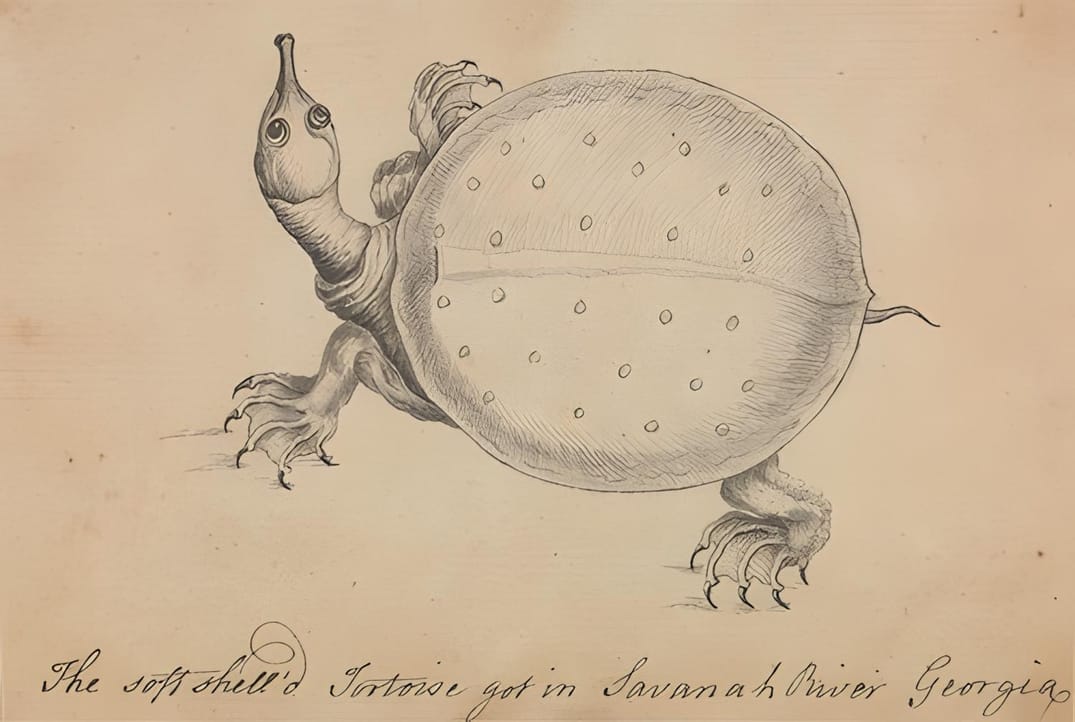
Its message: Listen to the snapping turtle, the one slick with river silt, its shell carrying two resting slugs.
I. THE WHERE
Geographic coordinates help us pin things on our phones. This location data doesn’t seem to make us any more interested in our location other than how it serves our mundane navigational needs of the shortest, least trafficked route to follow from place to place. I want to telescope out to the larger connected systems at play - the stars and the planets. We have long navigated by them, and our systems of navigation are still based on them.
Few of us know the latitude and longitude or even the altitude above sea level where we live, nor in any real way find it relevant beyond the relative temperature and how it may affect comfort. When stopped on the sidewalk and asked cardinal directions, we often fumble for our phones instead of turning our heads to the sun hanging in the sky.
Latitude is how we are situated between the poles and the equator. It divides the north and south hemispheres and is a literal reading of the sun and its apparent movement as we orbit around it. Latitude is about the length of day and night, the light and the dark. It is one of our standardized tools of navigation of air, earth, and water. And it appears magnetic north has become unbound from its former housing and has actually been actively moving quite rapidly as of late, at a pace of 40 miles a year for the past 30 years, and it’s headed for Siberia.
Longitude, the other standardized tool is about time as we understand and set our clocks by. Longitude is in relation to the notion of a “prime meridian” and divides what we have determined are the eastern and western hemispheres of the planet. Longitude was specifically based on the markings of when lunar eclipses occurred in different places by early Hindu and Greek astronomers and, most certainly, by many unreported others. Until the early 19th century, everyone had their own “prime meridian,” starting with the Greek astronomers in Alexandria, Egypt and the Hindu astronomers in Ujjain and Rohtak in India. Later, the colonial powers of Europe flagged their navigational zero in Fuerteventura in the Canary Islands, Paris, Berlin, Copenhagen, London… In other words, time has been kept track of according to the relevant place by the culture of place. Longitude is of a more human creation having to do with the political belly button of whoever is of influence.
Case in point: the Royal Observatory was set up in Greenwich east of London to specifically put to rest or stake a claim for creating an international standard of time telling. And from 1884 to 1984, all us on the globe have used Greenwich as our International Prime Meridian. However, this has shifted and we now tell universal time according to a point less than 100 meters to the side, a point called the International Reference Meridian, or IRM. This more recent reference point passes through a lot of water as well as land in eight countries in western Europe and western Africa. And still, this zero point doesn’t keep human time accurately due to the changes of our planet’s rotation, and therefore requires the periodic addition of “leap seconds,” a soft cheat to balance the Earth’s wobble.
Localizing, I and who I invited as contributors to an atlas were required to legally reside in the state of Illinois. We write literally within the legal state boundaries drawn by water to the west, south and east by the Mississippi or Big Water, the Wabash and the Ohio. Rivers actually make very practical sense as borders as they serve the natural world as such. However, Illinois’ northern border was a result of a shrewd political move, part of the effort to move the territory of Illinois into a state in the early 1800’s, which involved swallowing quite a bit of Wisconsin territory to secure access to Lake Michigan and thus the Great Lakes and the Atlantic Ocean. This water envelope both floats and anchors Illinois economically and politically.
II. THE WHEN
Plants tell us what time it is. Plants tell us where we are. They belong to a place and a time. They are located. They grow where they find themselves, though they have mechanisms of roots or rhizomes and mycelium and ever traveling soil microbes to connect them to other places and seeds that relocate next generations by wind, water, birds, ants, others. Plants, when understood as communities, have ranges of where they are usually found. These ranges are shifting as the climate is shifting.
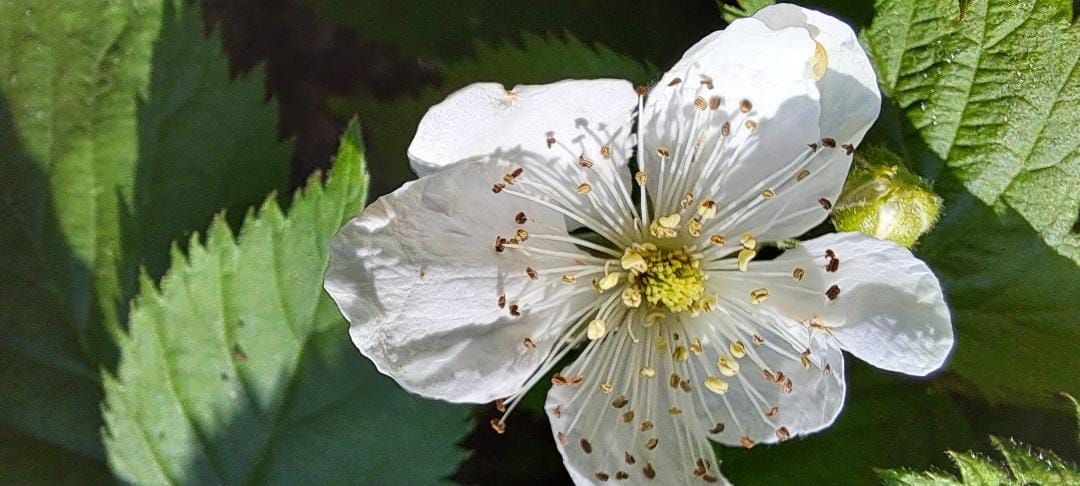
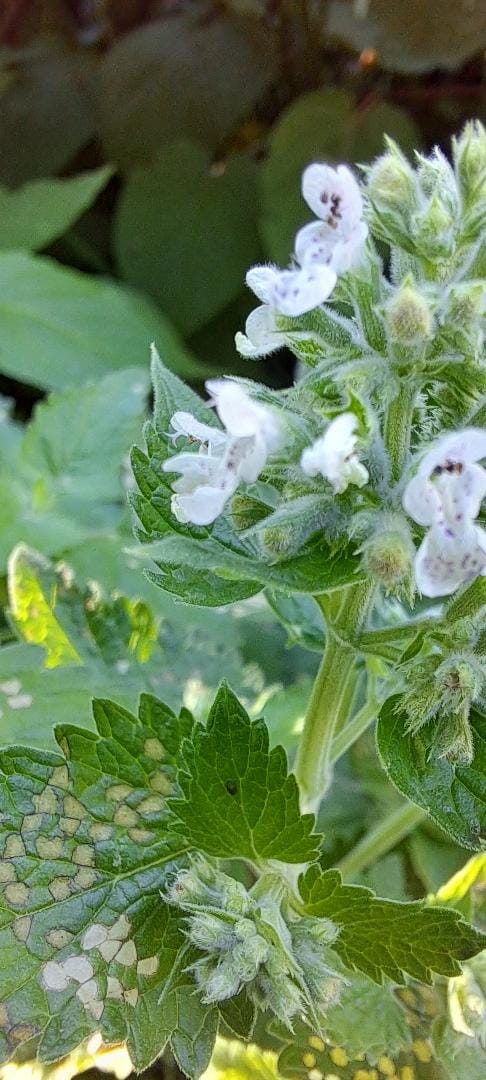
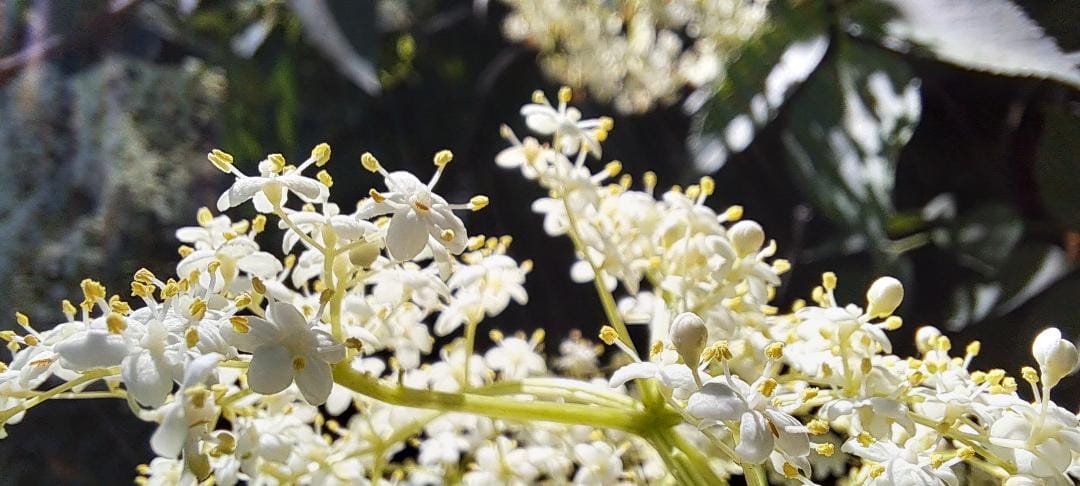
Focused engagement brings us into the present, increases the present. Paying attention grows Time and Place. In the here and now of me (44.24 degrees lat, 89.65 degrees long, 890’ above sea level), July is white flower time. And while there are others that bloom other colors, as I walk a transect of the ditch, field, prairie and woodland, there are 30 plants whose flowers bloom white during this month.
Names given to plants are many. Their indigenous names are numerous, depending on how they were spoken to the original peoples of a place. These plants all also carry botanical names, largely based on morphology, human use, or botanist. I am choosing common names, for ease of sharing. Here they are in the order that they came to mind as I sat here writing, not in their timing of bloom during this month or their placement within ecosystems.
Bladder Campion
Fleabane
Elderberry
Wild Phlox
Dutch Clover
Beesom’s Clover
Sweet Clover
Cress
Queen Anne’s Lace
Wild quinine
False Indigo
Penstemon
Meadowsweet
Culver’s Root
Plantain (both of them)
Red Twig Dogwood
Wood Anenome
Grey Dogwood
Yarrow
Chamomile
Common Mallow
Daisy
Blackberry
Rattlesnake Master
Dogbane
Hoary Vervain
Beggar Ticks
Chinese Milk Vetch (though you could argue this is cream and not white)
Potato
Plants determine the place of habitat and the sourcing of food for animals and microbes and even other plants that depend on them. Plants determine and respond to the timing of insects in all their metamorphic forms and of the birds, mammals and reptiles. Observation of the occurrence of these interrelationships birthed the monitoring tool of phenology - of measuring timing of biological events (emergence, migration, seed set, hibernation) over biological and geographical scales. Phenological records tell a story of dynamic cycles of change in a place.
An entomologist by the name of Andrew Hopkins developed his own calculations on how to share these phenological stories, these place-based timings. Hopkins' Law requires a geographical location as a point of reference carrying clear latitude and longitude. With that point one can calculate the relative timing of natural events, be they bloom time of plants, or mating or hibernation of animals, or emergence of insects, or migration times of birds, or frost line in soil. Even with with extreme weather events and temperature fluctuations over the twelve or so years of me following this, Hopkins checks out well.
Set a location.
+/- 1 day for each 15 minutes of latitude (N/S)
+/- 1.25 days for each 10 degrees of longitude (E/W)
+/- 1 day for every 100 feet of altitude (the sea!)
So Carbondale, IL and Freeport, IL have almost a month of difference of “biological events” between them, and Freeport and Chicago about a week.
III. THE HOW
I wake up and scribble a “punch list” on the chalkboard and the ducks clack their bills against the window so they can escape to their kiddie pools for their morning wading. I answer their call and I leave the house and step outside barefoot. Bird song, fragrance and breeze filters into my body, time expands and place becomes loud. The dogs run and bark to ward off whoever may be lingering in the tall grasses, the cats escape to the bird feeders. I offer food and water to the bobwhite quail and stop at the hose to fill my cup full of cold well water. The sound of the splashing instantly arrests my ducks. They stop in their waddle, cease their quacky babble and their heads snap into stillness at the ready.
And I am messaged again:
Boundaries are porous.
Palpate.
Hold bigger.
Tend the frog bodies.
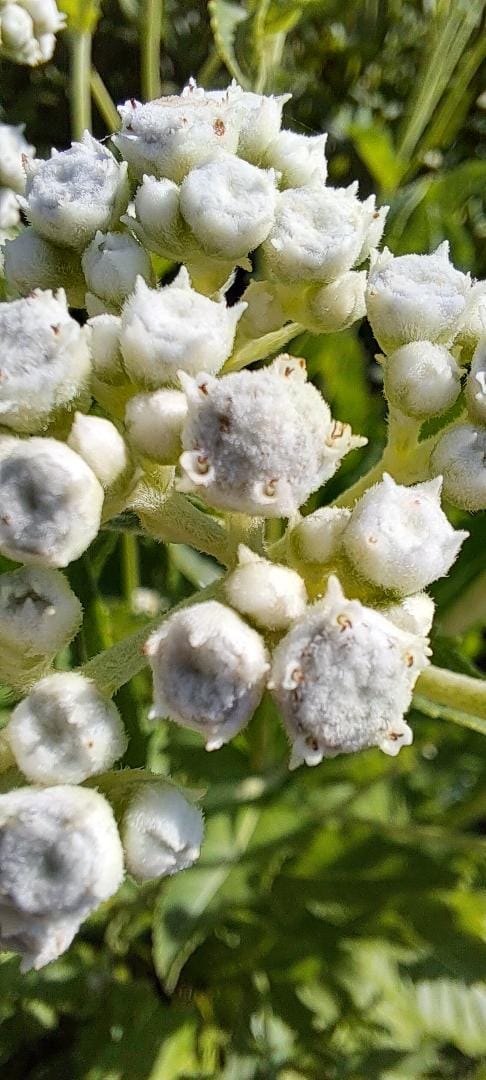
I dedicate this to Mark Watson, who was one of my many teachers and who inspired me in this essay. It was an invitation, almost imperative, for his students to forge an encounter with a plant. Although, as someone who regularly communicates with plants, this encounter was more than I bargained for. Poisons are high medicines. I am not surprised that such a large and poisonous plant came to meet me to open me up and remind me of my capacity to relate. Tragically and astoundingly, Mark died suddenly last year.
Thank you Mark. Thank you Charlotte. Thanks all of you at Dark Mountain for both holding the light and stoking the monthly fires.
More about land boundaries, indigenous names, flowering plants, and plant and animal ranges:
- The Newberry Library hosted an exhibition in 2024 called "Indigenous Chicago," which is part of a broader project to describe and map the indigenous settlements and places of the Chicago region. The invaluable maps and histories they produced are available on their site https://indigenous-chicago.org/storymap/
- Xerces Society, a non-profit that protects pollinators, publishes free guides for regional native wildflower bloom times, and soil and insect associations https://www.xerces.org/publications/plant-lists/native-plants-for-pollinators-and-beneficial-insects-great-lakes
- More detail about Hopkins' Law and how to apply it, from the Alabama Extension https://www.aces.edu/blog/topics/forestry/estimating-alabama-bloom-times-using-hopkins-bioclimatic-law/
- The Nature Conservancy has modeled the directions in which birds, mammals, and amphibians (and by implication plants) in the Americas are migrating in response to climate warming https://www.maps.tnc.org/migrations-in-motion/#4.74/34.91/-93.5
- Hilma af Klint's "spiritual atlas" of flowers https://www.moma.org/calendar/exhibitions/5779