

Part I of a conversation with Dr. Marcia Bjornerud, structural geologist
Over the past year, after I discovered the work of Marcia Bjornerud through a podcast, I read all four of her books and knew I had to interview her. In essence, it was necessary to spend time in conversation with such an embodied scientist who does give, the apparently silent rocks, voice. - nk
Nance: So Marcia, you make time for rocks. In particular rocks as they encounter and interact with force fields. I've been circling around you for such a long time. Because to me, you're the equivalent of the Canadian forest ecologist, Dr. Suzanne Simard. You two should meet!
I was wondering if you would share your current work in rock mechanics and perhaps allude to how your work has changed over time.
Marcia: So my field is called Structural Geology, which probably means nothing to most people. But it's about how rocks respond to stress in the crust that is largely called caused by tectonic movements. So in my field, we study how mountains grow. We understand that mountains are not eternal things. They have to come into existence in some time and then they are steadily and inexorably dismantled by erosion.
I've studied mountain belts around the world. My PhD work was actually up in Arctic Norway in Svalbard and archipelago between northernmost Norway and the North Pole, where I was studying the sort of northernmost extension of the Appalachian Caledonian mountain belt that formed Pangaea. And I've also studied in New Zealand and in Italy. And people may not realize that here in Wisconsin where actually we have at least two well-defined ancient mountain belts no longer topographically mountains, but we can tell by the way the rocks have been deformed and metamorphosed that there were mountains here.
This part of eastern Wisconsin is actually a really great place to study structural geology because you can look at the way rocks deformed deep in the crust in a collisional tectonic event and see things that we can't actually observe today. For example, we don't know really what's going on deep inside the Himalaya, but we can look at deeply eroded mountain belts like the ones in northern Wisconsin to get a glimpse of what's happening.
In my field, we think of rocks when they're deforming as extremely viscous fluids. They're solid, but they're flowing in the solid state and bending and changing shape in response to these stresses. That's rock mechanics, rock behavior. We have to use that word rocks behave in certain ways in different pressure temperature conditions. And in our mind's eye and in quantitative models, we can sort of envision that rocks in motion, rocks changing their shape, rocks reincarnating by recrystallizing into new forms. That's the sort of thing I do.
Nance: Would you situate us a little in the physical landscape that you inhabit? And share why you're you’ve made it your home for 30 years.
Marcia: I have been here for a while mainly because of the human environment that I'm in. Lawrence is a small liberal arts college with the wonderful conservatory of music. There's both a very rich intellectual atmosphere here and a very rich cultural atmosphere with all the music that's happening.
But It's a part of the state I did not know well. I grew up in Northwestern Wisconsin, sort of on the northern edge of the Driftless area with much more rolling topography. This is a notoriously flat area of the state which was under a glacial lake that we give the name glacial lake Oshkosh and those lake sediments late in the ice age blanketed any preexisting topography and the glaciers also did their job kind of scouring things. So it's a subdued landscape, although we have the Fox River, which is literally outside my window here. Lawrence is built on the banks of the Fox, which is a mighty river that flows from southern Wisconsin, northeastern into the bay of Green Bay, Wisconsin. From a historical perspective the Fox was very important in pre-European times because the headwaters of the Fox, which are near Portage, Wisconsin (the name is telling) are about a mile from the Wisconsin River, which is a major tributary of the Mississippi.
At Portage, for centuries, Native Americans would use the Fox to travel the whole Mississippi system to the all of the Great Lakes. In early 1800s, a canal was dug so remarkably, it was possible to travel by steamship from New Orleans up the Mississippi, up the Wisconsin River through canals that were built at Portage in the early 1800s and then down the Fox River, right past my office here and out into Lake Michigan. And so this part of Wisconsin, I've come to appreciate in spite of its kind of subtle topography. It has a rich history.
There was a Jesuit monastery, just not far from here as early as 1640. So there's a long history of settler and native interactions and the river has always been kind of the reason everything's here.
The university is actually a year older than the state of Wisconsin and older than the University of Wisconsin. The Fox, as it flows out of Lake Winnebago down into Green Bay, drops quite a lot of elevation and therefore a very powerful river. There were textile mills built in the early 1800s here. Amos Lawrence, the founder of Lawrence University, was from a big Massachusetts textile family. There’s lots of interesting entanglements in time and place here that over time I've come to appreciate. It's a place that has a deep human and certainly geological story.
Nance: We're talking from your office and I love the tumble of books behind but I’ve been looking for rocks and I think you might have some on your windows. I was expecting rocks on your desk and maybe a couple boxes under your feet.
Marcia: We're not in my lab!
Nance: Tell me a little bit more about what is happening in your lab with your students.
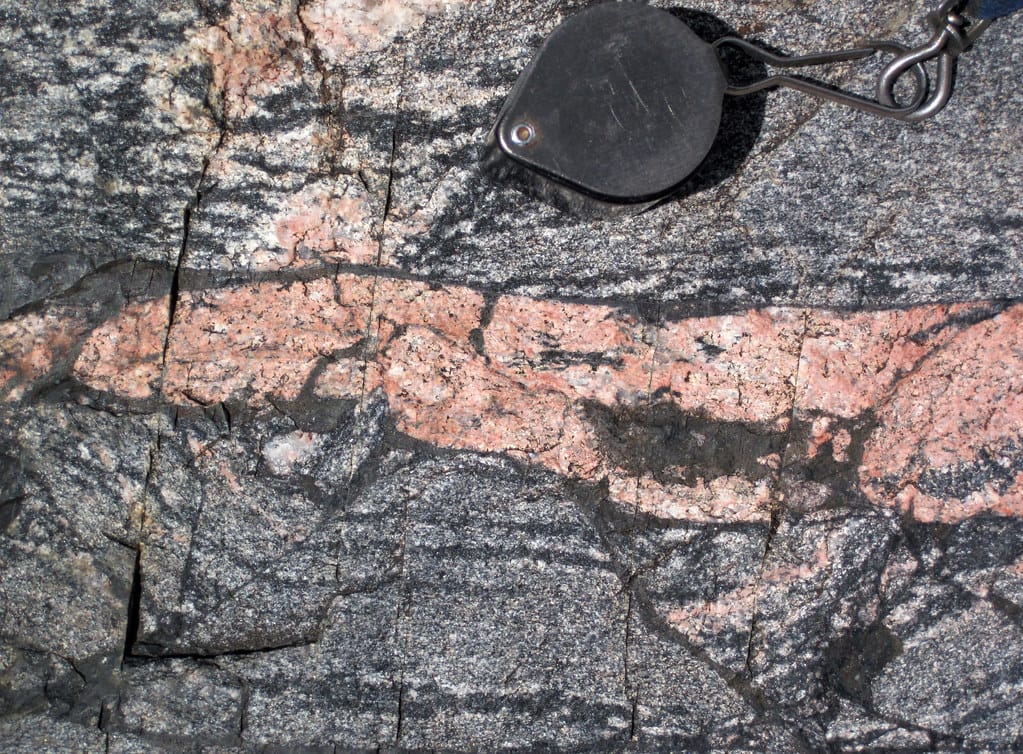
Marcia: Well, increasingly, partly because I've been in charge of taking care of my elderly parents in recent years, it’s been harder for me to take long field expeditions out of the country for sustained periods of time. But there's so many interesting and under investigated rocks just to the north of us up in the upper peninsula of Michigan. There was a lot of interest in the early 1900s due to mineral resources up there, but actually not a lot of work has been done since then. So it's a really fantastic opportunity for my undergraduates to do some really kind of fundamental work and investigate the really complicated rocks of the north woods. Especially the upper peninsula of Michigan, which record multiple tectonic events over a wide span of time. Recently, the oldest rocks in the United States were found to be in northern Michigan in the U.P. at 3.5 billion years old.
Nance: Are they gneiss?
Marcia: They’re very nice…. Yes, they are gneiss! There are lots of fundamental questions about how North America came to be assembled. One of these mountain belts that I was alluding to earlier is called the Penokean mountain belt, named for a little town up in northern Wisconsin. This was an Appalachian-like mountain belt that was formed about 1.85 billion years ago. We can see major fault zones, including some that had great earthquakes on them.
I've really been focusing on earthquakes the last 10 years or so studying a kind of arcane rock type called pseudotachylite, which is a glassy black rock that is the one unambiguous indicator of an ancient earthquake. This rock is generated by frictional melting in the seconds that an earthquake occurs by fault slip. It has a very distinctive look. It's the closest we can get, actually, to really seeing what is happening at the focus of an earthquake.
Today, when we experience an earthquake, it's the shaking we register but an earthquake emanates usually from five to ten miles into the subsurface when a fault slips suddenly and that release of energy is what we experience as the earthquake. But we can't really see physically what happened on the fault surface after a modern earthquake. So these once deeply buried fault zones now conveniently brought to the surface by erosion, give us a window into understanding the physics of earthquakes.
Nance: Well, we're getting a little bit into the history of the field of geology and I have read that a lot of geology emerged from miners looking for minerals, identifying veins in strata and then asking certain questions about how Earth came about and what the Earth is. Being able to age rocks as with so many discoveries and understandings in the field of geology is actually quite recent. Plate tectonics, as I understand it, was only figured out in the 1960s!
I'm wondering if you want to speak a little bit to this accelerated rate of recent geological discoveries as well as the discoveries coming from your own work?
Marcia: I find the history of geology really fascinating, because there is this tension that you alluded to between the kind of vinyl, pragmatic, extractive motivations, and then also the deep existential questions that geology addresses. It's interesting to me that the beginnings of geology were actually very philosophical. Geology as a discipline didn't really exist until the very end of the 1700s, early 1800s. People certainly were picking up rocks and using them and collecting mineral specimens. But it was really in the Enlightenment, and a particular Scottish natural philosopher named James Hutton, who was the first, at least in the west, to recognize that the earth was very, very old. It is probable in other cultures that weren't so influenced by the Bible, other people accepted that the Earth was very old. But the fact that the Earth was very very old, wasn’t the belief in the science and practice of geology and so Hutton was really outside his time in many ways.
Hutton was not motivated by mineral exploration. He was actually motivated by his religious beliefs that the God would not allow the earth to just be steadily worn down by erosion. In Scotland, he was a wealthy landowner. He didn't actually farm, but he noticed that he was losing soil to the sea every year and this troubled him certainly as a landowner, but it also troubled him as a believing person. He thought there must be some way that God rejuvenates the land. He developed this elaborate theory of the Earth that invoked a kind of internal heat engine. Again, he was in the Enlightenment and knew James Watts, the inventor of the steam engine. I think he was influenced by the technology of his time. Hutton correctly surmised looking at rocks that some were molten and that suggested a heat source in the earth. He famously found this location on the coast of Scotland, just south of Edinburgh, where he recognized two sequences of rocks, a sequence that was tilted and that represented an ancient mountain belt. There was a rubbly surface of erosion and then a new sequence of rocks on top of that. He recognized in that place evidence of a cycle of mountain building erosion, new deposition, a new land formed.
So Hutton gave us this idea of DeepTime and that the Earth, as we see it today, is just one version of many in what he thought was an endless cycle of rejuvenation and destruction and reincarnation. And that's a beautiful philosophical idea and was very modern in many ways. Today we realize the Earth is not infinitely old, but it's very much older than any human experience of time. And yes, it is dynamic and rejuvenating. So initially geology was really embraced by the public because of this revelatory world view that it offered. But then of course, as people started to create a geologic time scale and started thinking about the fossil record… And when Darwin suggested that we too were just another species that had descended from apes, then people started not liking the ideas.
And so as geology was embraced, it was this heady philosophical thing. And then further into the 19th century and as the industrial revolution got underway, the new science of geology became a very, very useful tool for finding coal in particular as well as other minerals. And that was when I think geology lost its way. It fell out of public favor because many people just didn’t want to accept the Darwinian view of life on Earth. But then again recently it got derailed by the pragmatic side that most geologists found jobs in extractive fields.
There was one other thing that I think really set geology back and I've written about this in a couple of contexts. It was soon after The Origin of Species came out (Darwin’s book), Lord Kelvin, the great physicist of his day, sort of an Einstein or Stephen Hawking, pronounced that the Earth could be no older than 40 million years old based on his assumption that the Earth had started as a molten sphere and had just been subsequently cooling based on modern rates of heat loss from the surface. What he saw correctly was an Earth that still had a lot of heat emanating from its interior. But what he didn't know is that the Earth has not just cooled from its start. It also has a way of regenerating heat through radioactive decay which had not been discovered in his time. But the effect of this pronouncement was really chilling for geologists who were beginning to understand the immensity of the time represented by rocks.
And Darwin, even though in his day there was no idea of DNA or heredity, his idea of evolution by natural selection to generate all the diversity of life on Earth would require hundreds of millions, if not billions of years. And Darwin was revered. But the great physicist Kelvin saying to geologists and to Darwin, you only have 40 million years to work with to explain all of this caused just cognitive dissonance.
I think about how it must have been to be working under that constraint that just did not make sense given what you were seeing in the rock record, would have closed imaginative thinking down. So its this combination of people not liking evolutionary thinking of geologists, going more into practical extractive industry activities and then also this great physicist not allowing geologists to think across great time lines making geology be in sort of the doldrums for most of the second half of the 19th century. And then it wasn't until the early 20th century that radioactivity was discovered, which both gave us a heat source that Lord Kelvin didn't know about and became the tool that allowed us to actually measure time.
Radioactivity is the way we can date rocks. And that was a huge step forward, but then it wasn't until the 1960s that finally geologists connected the dots and realized how the solid earth works and recycles its crust very much in the way cotton was imagining through plate tectonics.
And now we're in a time I call the “Golden Age of Geoscience”. We have plate tectonics as a unifying theory for the solid Earth. We have this idea of biogeochemical cycles that include rock and air and water and life over many different timescales that has become a discipline that really didn't even exist when I was in graduate school 30 years ago or more. We have climate science much much more sophisticated than again when I was in grad school. We have the computational capacity to crunch all those data. We also have real time monitoring from space where we can actually see plates moving in real time. We can monitor the climate. We have the conceptual frameworks. We have the analytical tools and the instruments to finally see the Earth in this much more nuanced way.
Unfortunately, the average person doesn't really know what geology is or geoscience is. It’s my experience that the average person has a kind of almost Victorian view. It's about dinosaur bones and mineral collections. Rather, I would define geosciences as really a way of seeing the earth in four dimensions.
Nance: Well, is that what has pushed you to engage the popular sphere with your very books that you've written, your stretch into magazines and newspapers? What is driving you to communicate not just with your students, but with a broader public because in general, scientists don't like scientists tend to be interested in their research and they're not the best with language. And you enjoy language so much! You're very lyrical and I'm wondering if you would speak to what got you kind of outing yourself as loving rocks so much and why you think other people should know more about rocks.
Marcia: Yeah, so I have a number of motivations. A major one is the sense that if more earthlings, and I do want to reclaim that term from science fiction, that's what we are. If more of us could view ourselves as earthlings and understood more about the planet on which we will live out our lives, we would not have so many serious environmental problems!
Again, we were saying geology is a kind of late bloomer as a science and it's too bad because if we had understood more about the climate system before we became so addicted to fossil fuels, we would not be in the climate predicament that we are now. And you know, the average person because of the late maturation of the geosciences just has not encountered geology in school, it might be represented in a very shallow way but it's really not part of most high school curricula in a really rigorous way. There are some exceptions and I want to acknowledge the wonderful earth science teachers that are out there doing good things. But for example, there is no AP test in geology that's telling you that it's not considered a prestigious field. So most people have just not had the opportunity to learn much about the way the Earth works. In my own teaching I emphasize more processes than just objects because geology is not just about rocks, it's about what the rocks signify. I often say rocks are not nouns, they're verbs, they're records of active processes.
So part of my motivation is pragmatic is that we are in a whole bunch of environmental predicaments of our own creation because of widespread lack of understanding of basic things like groundwater and the climate, soil formation, et cetera. But then I also think that some of the spiritual malaise that we're suffering as a society in late capitalism is due to a loss of a sense of connection to the land, to the planet at different scales. And for me, over time as I've spent now two thirds of my life really obsessed with rocks, I find great spiritual solace in really being able to read the story of the Earth and feeling this sense of continuity. There's a logic to it. I sometimes say geology is like the etymology of the world. It's telling us how things came to be. Word origins like, that word started as this thing and that's how we got this word.
That's how I feel often when I see a rock and I can read its stories like, whoa, now I see why this hill is here and you know how this place came to have the character it does.
I want to share that with people and I have this kind of evangelical urge to do that and I've been able to do that. I feel fortunate because again, at a small liberal arts college, there isn't so much emphasis on just pulling in grant money and training grad students and publishing three or five papers every year. Here we are expected to continue to do our scholarship and I love my research, but other kinds of scholarship are valued here.
I think one other influence was certainly I actually taught and had tenure before coming to Lawrence at Miami, Ohio, which is a pretty big research focus school. We had PhD students. I decided to move back north because I really missed winter and coming here and having to teach a much wider range of classes to undergraduates really broadened my awareness as a scientist. At Lawrence we also are all expected to contribute to our first year studies program, which is kind of a wow writing and reading intensive class. I think that's where I really started thinking more about writing for normal people, not other people who have rocks in their heads already. I can credit being here giving me the time and giving me the kind of inspiration to think about other kinds of writing. So yeah.
Nance: When you talk about if we had the understanding of the Earth then we would do things differently, I feel like the understanding is more of a knowing that creating through care, making time for a typical relationship with Earth or rocks, it's creating the time for that. And that's why you make time for rocks because by making time, it's a form of care and through care, creates value… I wondered if you wanted to read a passage now.
Marcia: Sure, I just happened to have Origin of Species right here. Many people know of this book Origin of Species written in 1859, but I don't know how many people have actually read it. If you sit down and read it, it is a long and very humble and sometimes very dull exposition of one big idea. 2009 was the 200th anniversary of Darwin's birth and on his birthday, which is February 12th, I organized an all day reading of Origin of Species in our library. I had people reading in15 minute chunks that they had signed up for. We started early in the morning, we went all day long and the effect of that hearing all these people reading his words was really moving.
His voice comes through. He was a Victorian and he had certain ideas that we might not agree with, but he was a deep thinker and a very anxious person and it comes through to his writing, it’s all very carefully, almost hesitantly written. The very last paragraph, I think, is a beautiful example of evocative science writing, so I thought I'd read part of that.
Nance: Please.
Marcia: So this is the very last paragraph of Origin of Species:
‘It is interesting to contemplate an entangled bank clothed with many plants of many kinds, with birds singing on the bushes, with various insects flitting about, and with worms crawling through the damp earth. And to reflect that these elaborately constructed forms so different from each other and dependent on each other in so complex a manner have all been produced by laws acting around us. These laws taken in the largest sense being growth with reproduction inheritance, which is almost implied by reproduction variability from the indirect and direct action of the external conditions of life. And from use and disuse, a ratio of increased so high is to lead to a struggle for life and as a consequence to natural selection and tailing divergence of character and the extinction of less improved forms. That was a kind of retrospective on all the chapters, basically. But this is the sense, the two senses I love, thus from the war of nature, from famine and death, the most exalted object, which we are capable of conceiving, namely the production of the higher animals directly follows.There is grandeur in this view of life with its several powers, having been originally breathed into a few forms or into one. And that whilst this planet has gone cycling on according to the fixed law of gravity from so simple beginning endless forms, most beautiful and most wonderful have been an are being evolved.’
Marcia: Long sentences, but I think what he's trying to do there is from all of the technical stuff that has come in the book about pigeon breeding and horse breeding and examples from the fossil record. He's then trying to elevate people's vision to say, this is a remarkable and awe inspiring thing to think we are all related that from one original life form, look at the creative diversity that has emerged. It's very Victorian, but I see this deeply soulful person behind the words. So yeah, If you read it skip the pigeon breeding parts.
Nance: The Huntington Library and Gardens in San Marino, California holds the most versions of that book. I was in L.A. during that anniversary, I was teaching there and they had a huge display of all the copies of Origin and the Species, it was incredible.
Marcia: I mean his ideas have been abused by others, but his thinking remains at the heart of our understanding of how diversity emerges on Earth.
Dr. Marcia Bjornerud is a structural geologist whose research focuses on the physics of earthquakes and mountain building. She combines field-based studies of bedrock geology with quantitative models of rock mechanics. She has done research in high arctic Norway (Svalbard) and Canada (Ellesmere Island), as well as mainland Norway, Italy, New Zealand, and the Lake Superior region. Bjornerud is a Fellow of the Geological Society of America and has been a Fulbright Senior Scholar at the University of Oslo, Norway and University of Otago, New Zealand.
A contributing writer to The New Yorker, Wired, the Wall Street Journal and the Los Angeles Times, she is also the author of several books for popular audiences – Reading the Rocks: The Autobiography of the Earth; Timefulness: How Thinking Like a Geologist Can Help Save the World and Geopedia: A Brief Compendium of Geologic Curiosities, and Turning to Stone: Discovering the Subtle Wisdom of Rocks. Timefulness was longlisted for the 2019 PEN/E.O.Wilson Prize for Literary Science Writing, and was a finalist for the 2018 Los Angeles Times Book Prize for Science and Technology.