
According to the oral tradition of the Anishnaabeg, Kitchi Manitou (the Great Spirit) made the Crane and sent it down from the sky to make its abode on earth. The bird was endowed with a loud and far-sounding cry, which was heard by all. Seeing the rapids (Bawating) and its multitude of fish, the Crane decided to make its home here. Upon hearing a loud cry sent out by the Crane, the Bear clan, Catfish clan, Loon clan, and Marten clan all gathered at Bawating. The Rapids then became the gathering place for the five major clans of the Ojibway Nation, and the Crane clan (the Echo Makers) was chosen to preside over all councils.
-Phil Bellfy, “Three Fires Unity”
~~~~~~~~
The first great west of North America, for American settlers, was not what today we usually think of—the arid steppes, deserts, and high mountain ranges of the Colorado plateau and Great Basin. It was the Great Lakes—the old Northwest Territory of what today is Ohio, Indiana, Michigan, Illinois, and Wisconsin, as well abutting Canadian lands, which was to be left to the original inhabitants of North America as a “buffer state” at the turn of nineteenth century under the protection of the British.
There were forests and swamps and prairie in this west. But the large bodies of water were, really, central. The Ojibways, Odawas, and Potawatomi, collectively the Anishnaabeg, an Algonquian-speaking people sometimes also called the “Three Fires” confederation, anchored themselves in particular to Lake Huron, Lake Superior, and Lake Michigan and their bays and rivers. Anishnaabeg stories tie the founding of this landscape to the waterfalls of the St. Mary’s River between Lake Superior and Lake Huron, the “sault” of the old French city of Sault Ste. Marie, along the border of Canada and the United States, and known to the Anishnaabeg as “Bawating.”
Americans from the east coast did not for the most part enter these lands past the Appalachian mountains. These were the territories of the Miamis, Illinois, Kickapoos, Mascoutens, Ho-chunks, Missisaugas, Eries, Wyandots, Ojibways, Odawas, and Potawatomis, solid but loose and overlapping and shifting, according to needs and intertribal relations and sometimes war. For the Three Fires, the lakes which would later form a border between Canada and the US were laden with sacred meanings, and were a broad territory they moved around in by season, often by boat.
Of course, we know that Americans did enter those lands. This story is told in the form of wars and treaties and broken treaties and forced marches of native peoples to reservations and the establishment of farms and cattle ranches and cities and railroads and canals. Important places like Bawating and Michilimackinac, which for the Odawa meant “big turtle,” and was also sacred, were converted into towns of Canada and the United States - Sault Ste. Marie and in the latter case, Mackinaw City, where Lakes Huron and Michigan meet. Chicago, the quiet portal between the Great Lakes and the Mississippi River at the far south of the region, where small Potawatomi camps and villages sat amidst scrubby sand dunes, oak groves, and shallow interconnected rivers and marshes, was at the heart of this shift and became a new center of a new world.
But the universe of the lakes was lost as well. The expanse of the Great Lakes, with its bays, islands, and connective rivers, was still physically present, of course, though Bawating was dammed, and there are a number of present Anishnaabeg reservations around the lakes, especially in Canada, such as on Manitoulin Island in Lake Huron and just across from Detroit on Walpole Island (Bkejwanong)—but its form changed, to a border between countries and giant shipping highway. Chicago was the capital of this highway, which allowed grains, meat, lumber, and mining products to circulate east, west, and south in the newly expanded US of the nineteenth century, down and up the Mississippi, onto railroads and canals, and out to sea.
Recently, we spoke with two people who’ve written about and made art related to the Great Lakes and other waterways in the US—Rachel Havrelock, the director of the Freshwater Lab, an organization based at the University of Illinois-Chicago that studies the Great Lakes, and Marie Lorenz, an artist who has taken as a subject rivers in east coast cities. Rachel talked with us about her motivations in forming the Freshwater Lab, which both educates about the Great Lakes and seeks to protect them and bring stakeholders together, including indigenous people. Interestingly, she explained her draw to the Great Lakes by way of a different part of the world, Israel/Palestine, where she’s written about the destruction of both the Jordan River and the Gaza aquifer. She told us,
I actually have to say with a lot of sorrow, and from the bottom of my heart, I completely wish this isn't an example that I had to give. There are two things that I witnessed over my time being in the Middle East. I witnessed the diminution of the Jordan River. The Jordan River is holy to over half of humanity, it is at four percent of its historic flow. I saw it go down to three percent, but the work of environmental diplomacy got a little water diverted back into the watershed.
The Jordan River is essentially a storied river and to watch it die, and for it to be restricted by land mines… Between the border and the military and the land mines, a lot of water protectors can't even get to that water.
I also witnessed the aquifer beneath Gaza collapse. I hope by the time we read or hear these words, again, at least this present horror ends [the 2023-25 war in Gaza]. Because how can you have a healthy society around a dead river and a collapsed aquifer? It's literally not possible.
To suddenly see water like that gone, especially such famous water that's holy to people, you just think, wait a second, nothing's immune. And for me, having grown up around the Great Lakes, I love them so much. I am an open water swimmer. I just can't say enough about what these waters have given me in terms of healing and peace and being refreshed… I thought of my colleagues in the Middle East bringing people who have been in hundred years of war together to study water, to plan and to build relationships around it..
We in the Great Lakes have really violent histories of colonization and dispossession and industrialization and deep forms of racialized pollution and histories of undue burden. The water is amazing here, but the histories are also really, really painful.
We asked her what it’s like when an aquifer doesn’t just drain, but collapses:
When it comes to aquifers and groundwater, part of the problem is we don't see them. That's why it's under-regulated and not appreciated in Mexico City, for example, which just keeps sinking due to the aquifer falling. You look out and you see Lake Michigan, and you're filled with grandeur and wonder and, how can your heart not be filled with love? It’s surface water. And I’m not saying it doesn't get abused, but surface water is seen, and groundwater, we don't see it.
So you don't see an aquifer collapse. What you see or you read about or people report is like seventy percent of the young people having waterborne diseases. So, it comes up in that way. It comes up in people, and now it's gotten so much worse. Going back a few years of people waiting till trucks come by and paying top dollar for water, they don't know where it is from and probably nobody knows. And it comes down to people just digging to try to access potable water.
What happened in Gaza is that when the groundwater was drained, that space was filled with seawater. So suddenly the life producing water completely drained, that infiltration of seawater, causes salinity. But also consuming that water is just really dangerous. So the aquifer beneath Gaza collapsed in 2020. And already, even before we had the pandemic, and all the other issues to worry about, this was under-reported. And again, from my point of view, the decimation of a watershed doesn't stop there. We can't do society without it. We can’t grow food. Human life can't be supported. For me, witnessing those things was the wake up call of wake up calls.
For Rachel, the Freshwater Lab is an effort to restore a community around the Great Lakes:
In this work of water diplomacy, it's about bringing different forms of knowledge together - indigenous knowledge, front-line knowledge. I found in this work with a lot of different people, it's often community-based leaders from the most polluted, most hard hit neighborhoods that are carrying an inordinate burden. And that's usually who has the best ideas about our future, right?
Our society keeps them away from these sites of power and change and these are the people that have to come up. If you just kind of bring people to a meeting, the same people who think they know everything and have all the authority are going to talk over the others. We also need those people to listen to front-line experiences, to young people's and indigenous experiences.
So, one scale of this water diplomacy is making the space of sharing and learning and workshopping ideas all together, but with a lot of attention to these dynamics of power, so that we don't reproduce what's been done. And then interconnected with that is also thinking about how to bring these different leaders and water visionaries together. I mean, it's part and parcel of the same thing, the bringing together the sharing and the learning. And then figuring out, how do how do we move things on, how do we have better regulation, better policy, improve the access, widen the beneficiaries and things of this nature?
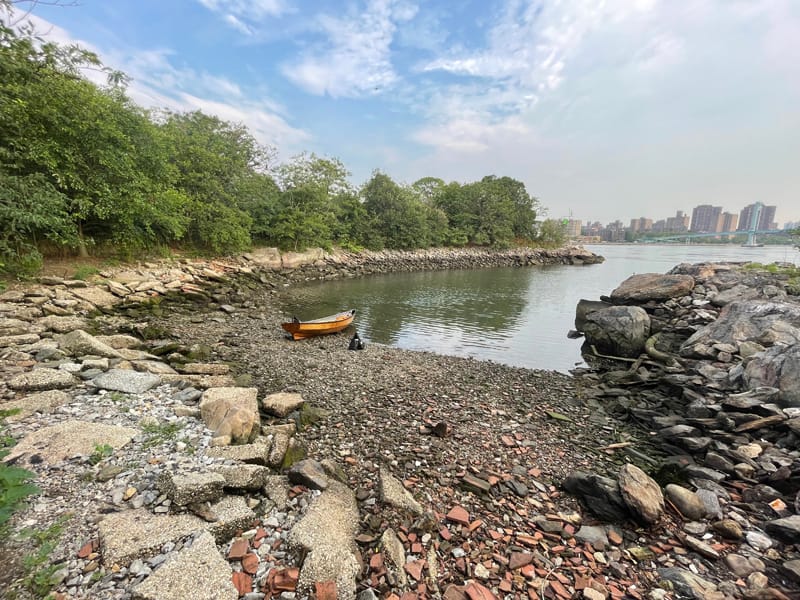
Marie Lorenz spoke with us about a different way of connecting with waterways. In 2005, she created a project called Tide Taxi, which addresses the experience of rivers and movement in cities. Her project is documented online, over many years. We asked her about the origin of Tide Taxi:
My family was always camping and canoeing in small boats. When I moved to Providence to attend Rhode Island School of Design in the mid ‘90s, the city was daylighting the Woonasquatucket River, which is buried when it goes through downtown Providence. They were ripping up all these roads and bridges to reveal the river, and the whole downtown was this construction site. They were revealing what I now realize were drainage and sewers, and I was making little boats and we were navigating into the sewers and would go for miles underneath the city in this network of tunnels.
We were inside these drainage tunnels, possibly combined sewer systems. So I was making boats that could fit into those spaces. And we had like a little clubhouse hidden under a bridge where we could raise the boats up on pulleys. And there was one point where you had to swing and pass yourself like a sloth under this I beam and over the water and then get out to the rope and then lower it down. And then you could put the boat in the water and get all your friends on board and go around and explore the city.
And so that's when I looked at the river and I was like, why aren't there people in canoes in here? The answer that people gave is because it's toxic, and because it's dangerous, and you can't touch the water, your arms will fall off or whatever. But that's not true.
So I was approaching the city waterway the same way that I had approached lakes and rivers as a teenager. That became an art project that I continue today. Cities in their industrial period polluted the river and turned away from the river. And now these really beautiful forgotten spaces just seem to me like backdrops for an opera or an adventure, and it seemed natural for me to make rafts, make boats, make things that people can be in in those spaces.
For Marie, Tide Taxi is a way to reconnect everyday life in a city with the life of a river. She told us,
When I moved to New York in 2002, it took a few years to understand that everything was so much more. The current is more, the traffic is more, everything is just bigger and more daunting in New York. So, it took me a couple of years, but I started the Tide Taxi project in 2005. And that's when it all kind of crystallized for me and I made a blog about it, using people's navigation of stories online to mirror the navigations that we were doing in the city.
I sent an email to everybody I knew and said, you tell me where you want to go in New York City and I'll study the tidal charts and we'll use the tide to get you where you want to go. It's like a taxi but we're using the tide to propel us, which is significant in New York and different from almost any other city. The river has this huge force of water that's moving around the city, changing twice a day.
And I wanted to kind of tap into that rhythm that's invisible, unless you know what to look for. I do a blog about the Tide Taxi every year. On every trip I take pictures and write a story from the perspective of the participant. And the blog goes all the way back to 2005. I usually do between five and twenty trips a year. And those are archived on the blog in the same way. It’s just a picture and a line of text telling the story of our trip.
There's a theme every year. I ask people to think of a trip that's within a prompt every year. The prompts are really open-ended and sometimes I'll really want to take a trip, but it doesn't quite fit the prompt that I started. So I'll just kind of make it up as I go.
Slowing down is a big part of the project. This is something that is lost when, as in the Great Lakes, waterways become channels for the transport of products. As Marie put it,
The best theme was so difficult that there were only three trips that year. The prompt was to stay out for twenty-four hours in the city. That was really awesome, that one was so fun. The summer before I'd done a navigation of the Erie Canal from Buffalo to New York City camping and being on the river day after day, and it was just so inspiring. And so I was like, oh, the Tide Taxi could have these nights out that would just be like amazing. And so we did three trips that year. It was so intense. It was cool.
On one, we stayed out for twenty-four hours in Newtown Creek [a tributary of the Hudson River]. We camped out on this dock behind a building that was invisible from the street. We just pitched tents on some industry's dock and we stayed out on this half sinking barge in the Arthur Kill waterway.
The nights were amazing, to camp out in the city. But my impulse would be, okay, we’re done with our camping trip, let's go home at 5:30 in the morning or whatever. We would start the trip in the afternoon, sleep, and then we had to stay out till four o'clock the next day. Those long mornings of trying to figure out what to do and just having these hours in these spaces, it was great.
So, that was the most difficult one. My first year of the Tide Taxi, I didn't even know that I would continue it. I thought it would just be one year. And the theme that year was “taking people to work.” So you told me where you work, basically, and we took you to work. Everybody was sort of just playing along. I don't think I really took anyone to work. One person actually had her backpack with her, she teaches in the Bronx and she was on her way to work. But everybody else would just sort of say, let's pretend I work in midtown or whatever.