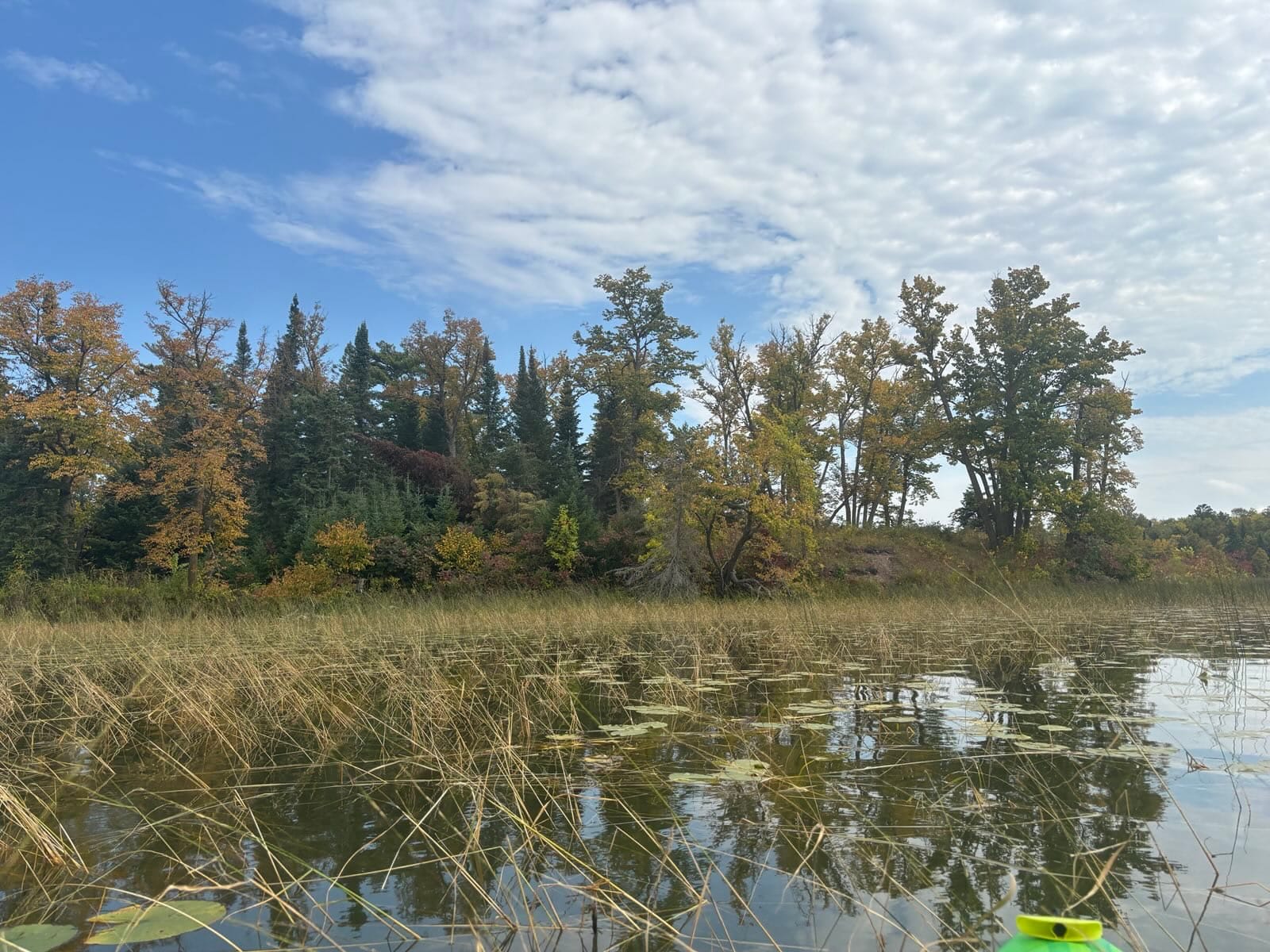
Upon arrival, I put down my bag and went down to greet the water—warm, clear, plant-rich with arrowhead, bulrush, rice. I was invited to join a wild ricing camp at the headwaters of the Mississippi in Northern Minnesota. This area of Anishanaabe territory is an uncut stand of old growth pines holding and anchoring a dense, spongey and multilevel canopy of diverse species all building the humus content of its volcanic mineral origin. Shallow waters of Omashkoozo-zaaga’igan, or Elk Lake (named Lake Itasca in American maps as a shortening of the Latin veritas caput, meaning “true head”), trace the forest of red pine, ponderosa, fir, hemlock, birch and basswood, its shorelines rimmed with rice.
Manoomin, the wild rice, needs clean, quiet waters. So does Ginoozhe or the American eel, who also swim in these waters, traveling the length of the Mississippi, out into the gulf and to the Sargasso Sea to spawn.
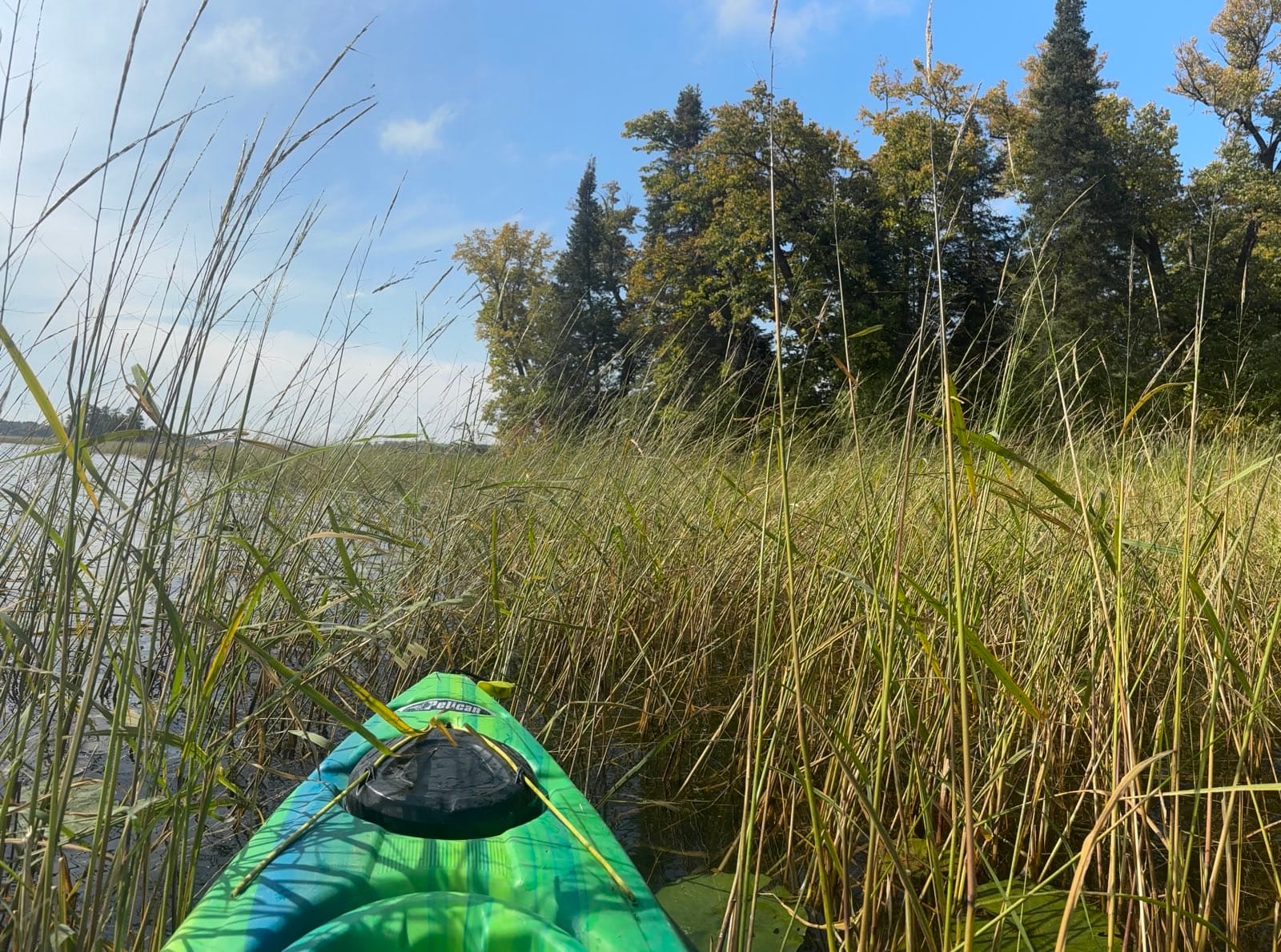
I spend quiet mornings paddling the shallow waters to meet both the water and the rice. A rice plant’s roots are nominal, just enough to anchor its long culm or stem that emerges from the water and holds its heavy inflorescence of seed or, as its Anishinaabe name Manoomin informs us, its berries. I stop paddling and let the kayak’s keel part the rice beds, sounding a feathering rain of both rice and rice worms into the water and into the boat’s hull, onto my legs, clothes, and the top of my head. Rice spikelets are densely packed and long, the worms feasting on them starting at the bottom and hollowing the hulls of grain as they travel up and then once all emptied spin and raise a small brown flag of a cocoon at the tip.
I pick up the worms and set them back on their food source. They seem to jump at the stems and attach like magnets. Later I find out from the ricer that their pinch is as strong as a wasp’s sting. Upon my return home, I find two hitchhikers in my bag which I feed to one of my hens.
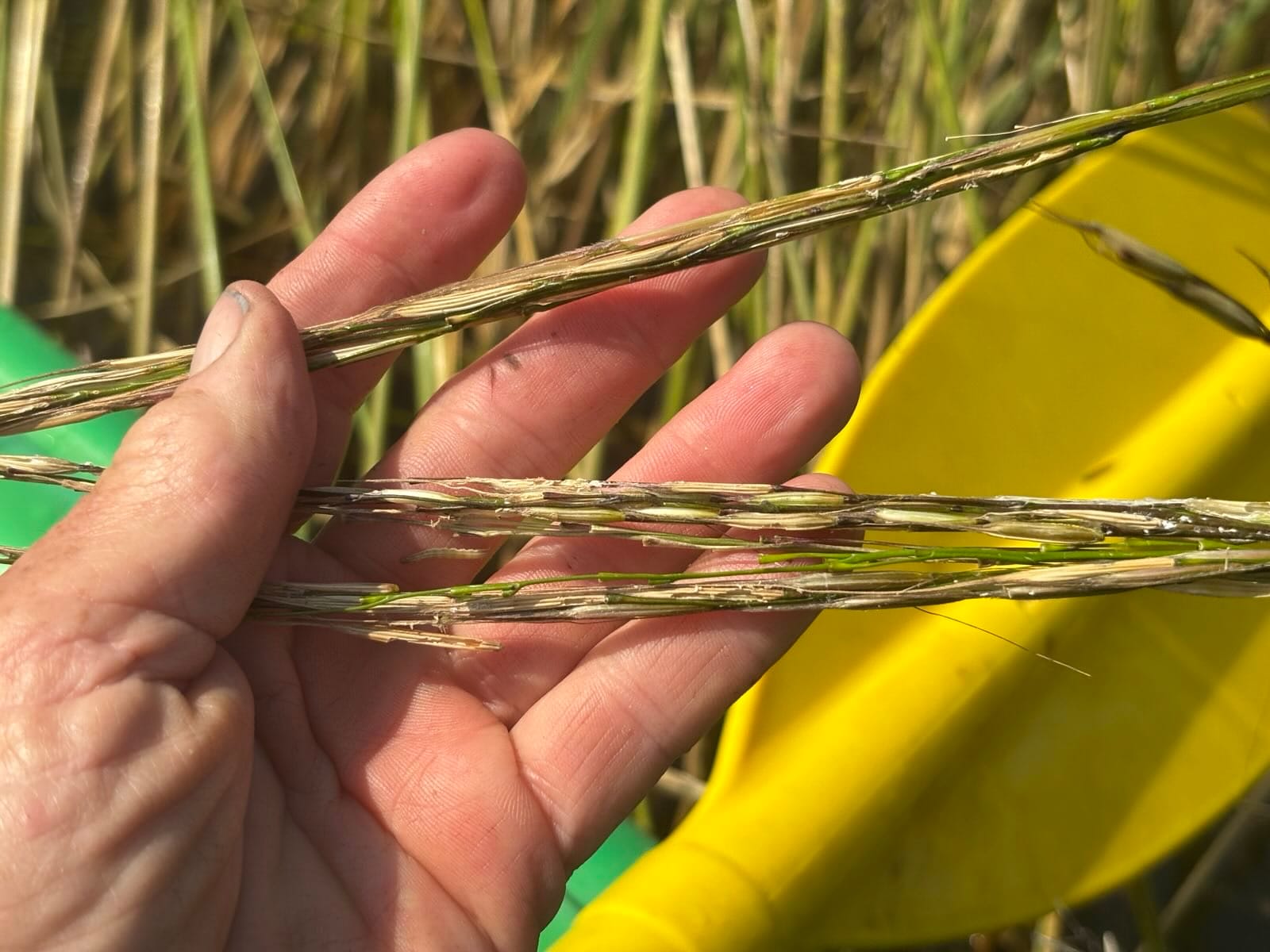
The awns are longer than the berry itself. I wade the shoreline and pick a few grains still stuck on my shorts and drop them one by one into the water. Heavy, the rice rockets down and drills into the silt. The awl acts as an aid to spin and drive to the depth the seed plants itself. I drop grains as I walk the waters edge, my feet feel the fine sand, silt, dense mattings of roots go—planting rice.
+++
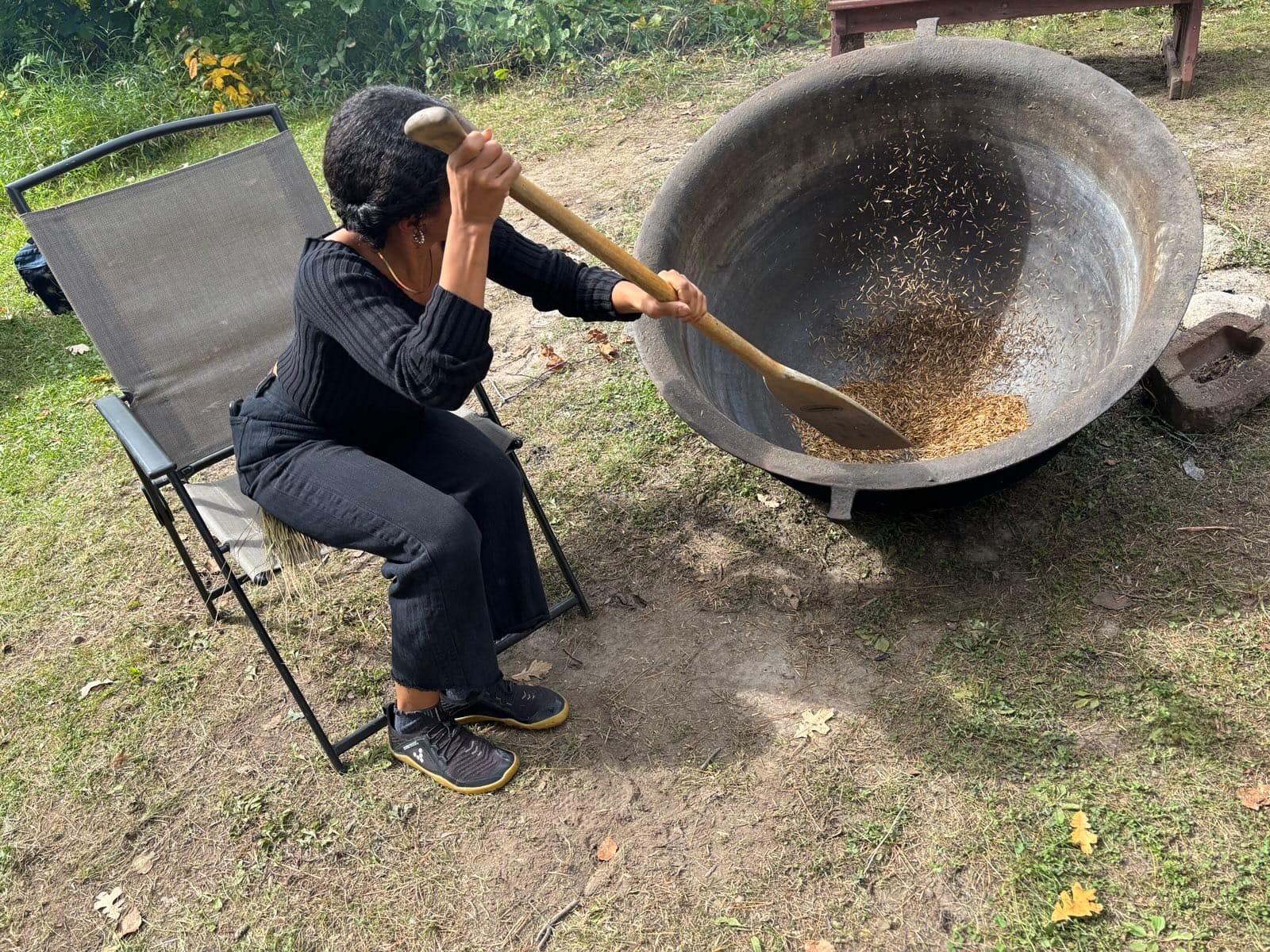
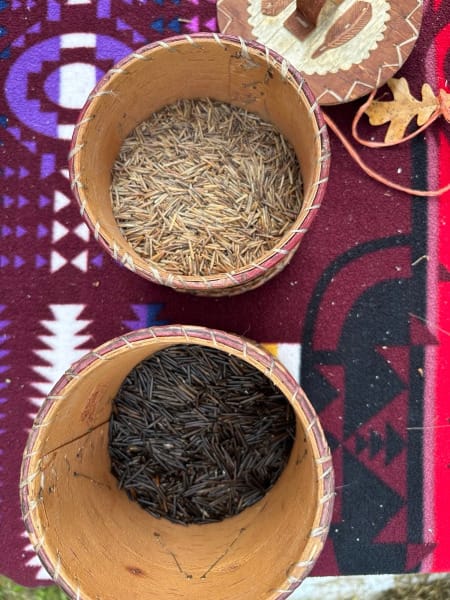
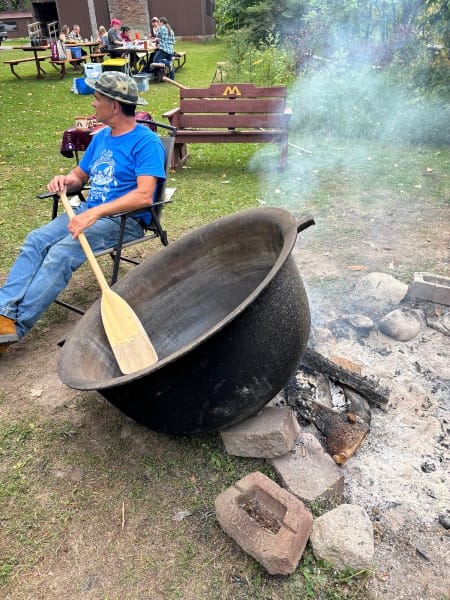
The ricer is sitting next to a fire made of split pine balancing a cast iron cauldron right out of a medieval scene—it must weigh close to two hundred pounds. He is holding a canoe paddle which they use to periodically scrape and scoop the rice and to toss it onto the hot sided kettle where it cures and parches and falls back down where it is kept warm. He is able to parch three to five gallons at a time. Parching seals the berry and allows it to be stored until needed. A gallon of rice weighs seven pounds. A pound sells for $28. This is a sustainable economy.
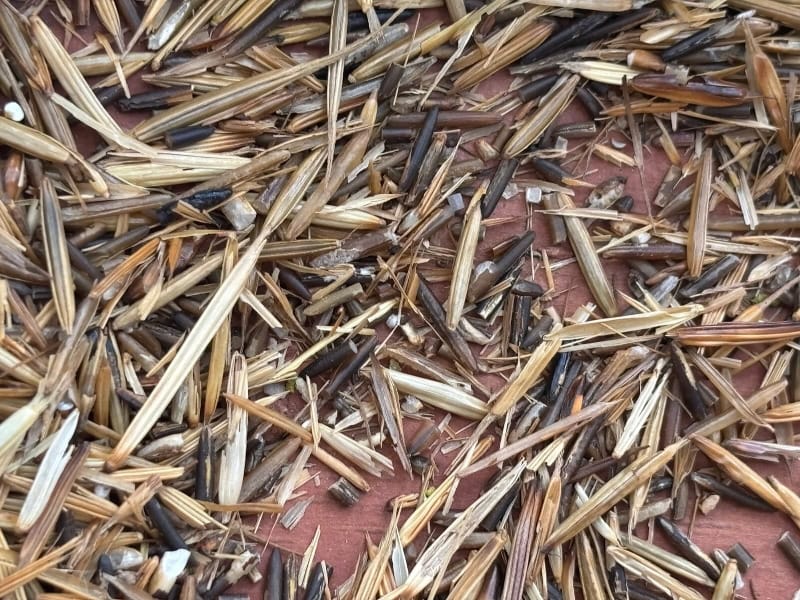
Before parching, the hulled rice is lightly ground so it can be separated from the hull. Traditionally this was done with the balls of ones moccassined feet, stepping and twisting. Instead, he has rigged up a stand threaded with two seven and a half pound barbells on a blanket, to save labor. To be able to parch on his own. The rice is considered done when it smells toasted, when the hulls are so dry and fine that they fly through the air with each oar scrape. It is then put into low woven trays (birch) to cool and then bounced to lose hulls to the breeze, and the rice is cleaned and ready for storage.
+++
Kayaking allows me to understand water and land and I spend the next few mornings making collections of shoreline soils, taking detailed notes on the unique plant communities who collectively work the soils. Afternoons I bike through the forest and do the same.
Granitic ridgeline soils. Basalt. Olivine. Potassium Feldspar. Quartz.
I see a steep wall of the island scraped of vegetation. I grab at the base of shrubby sumac anchored into the soil and pull myself up to look at the exposed wall of soil and study its horizons and surface pitted with straight walled, gallon sized holes. Each hole is littered with crumbled soft shells, a desiccated baby snapping turtle in stop motion at the edge of one of them.
+ + +
The origin of a lake can be from a melted glacier, and be fed by underground springs, rivers and streams. Lakes have a tendency to fill with silt delivered by moving water unless they have an outlet that can pull water and its suspended silts on through it.
Rivers, being more directional flows of water, are defined by what is downstream and what is upstream, its watershed and its headwaters. Spring meltwater, underground springs, precipitation and surface runoff accumulate to build flow of a water body or source stream.
There is a large stone marker erected by the Army Corps of Engineers at the so-called source of the Mississippi. A visitor center, small interpretive museum, gift store and parking lot are near by. The area around the marker has been designed to aesthetically move water along a naturalistically landscaped, engineered channel.
Defining the beginning of a river is still a murky pursuit. In the 19th century, white male settler-explorers, many self-made geologists, posited their theories on this for the Mississippi.
In 1832, explorer Brink argued that the point source was the farthest point upstream where the flow and volume first constitute a “river.” Schoolcraft, the eugenicist, ethnographer and geology scholar who has been popularly credited with the discovery of the point source of the Mississippi, and who came up with the name Itasca for Elk Lake, adopts this as his as well.
In 1836, French fur trapper Nicolette deemed the beginning of the river the farthest point upstream where the first drop of water falls.
And later in 1881, soldier and explorer and mapmaker Glazier determined it was at the highest point in a river’s watershed.
+++
At breakfast one morning, I discuss this with Shelley Buffalo, a Meskwaki corn keeper. I tell her, “Rivers like the Mississippi have numerous and braided tributaries, some above ground and some below ground, headwaters are more broadly gestured to with a sweeping arm. River origins are softer, more braided….whole areas birth rivers.” And she nods and returns with, “Mississippi’s origins are Matriarchal. Queer.”
On our last day, Shelley adds, “If we are invited to be here, to have conversations together, to rice together, what if we did something together that would actually give back to the Waters?”