This is the second part of my conversation with Dr. B where we speak to her popular writing, her work addressing the concerns and anxieties of a changing climate and the curiosities that are pulling at her now. - nk
Nance: Your motivations really help me understand how you've managed to stay clear of working for extractive industries. Again, most geologists go into oil and gas mining. It's also your pivot of moving from a research university to a liberal arts college where you're able to explore and expand your ideas differently.
I’m really interested in how your work and your thinking meet the questions your students come with, the concerns they have about groundwater or contamination. How have you been stretched with some of the concerns coming in from young people and what they're seeing happening in the world and putting themselves in a position to do something about it?
Marcia: Absolutely! I mean, I've been in the field long enough now to have seen several generations of students and a sort of pendulum swing back and forth. These days, especially here and at other probably liberal artsy kinds of places, it's the minority of students who would be going into oil, gas, and mineral exploration positions. Many of them go into environmental careers of one kind or another, either as scientists or environmental lawyers or policymakers or city planners. So they're using their geology in very practical ways, sometimes explicitly to clean up the mess that previous generations of geologists helped to create and not just geologists, but society in general.
I would say the biggest challenge is trying to mitigate general despair about climate and the state of things. I sometimes look back at earlier versions of notes and presentations that I had, I was exhorting people about the reality of climate change. These students grew up with that, they know it's real. It's happening in real time around them. It's more important for us to help them find ways, as you said, to help mitigate the effects, or understand better how close we are to tipping points and what we can do about it. So I think it's really important to find this fine line between conveying the urgency, but not tipping people over into despondency and hopelessness.
Right now I'm teaching the class I like to teach the most, it's called ‘History of Earth and Life’ and it is exactly what it is. In a 10 week trimester, I am teaching the whole four and a half billion year story of Earth. I mean, it's absurd. It's exhausting.
Nance: You’re like, “hold on to your seat!”
Marcia: Every night! There's just so much content! So I'm always asking, what is the story here? And if I had to say, the story is one of resilience and durability, creativity. The Earth has changed in so many ways over time. We've had terrible mass extinction events and climate crises, and yet life has persisted. That's not to minimize the damage that we're doing now to the current global ecosystem, nor to minimize how much human suffering will result if we don't get our act together soon and really act on climate issue. But, in the long view, it is true that Earth has been through a lot of traumatic things and life has never been extinguished. It has always rebounded, sometimes on time scales we would not like to acknowledge. It is resilient and I find some kind of reassurance there. That's one message I can honestly convey to students. Earth is very durable and reliable and Life is resilient and creative. We should respect that and try to foster that rather than just being agents of destruction.
Nance: I get a sense that you spend a lot of time outside. And that given your commitment to engage learning with your students that fieldwork is part of that, to physically connect people to what they're seeing. Would you talk a little bit about how fieldwork is a primary teaching tool to expand and deepen those knowledges and those understandings of processes?
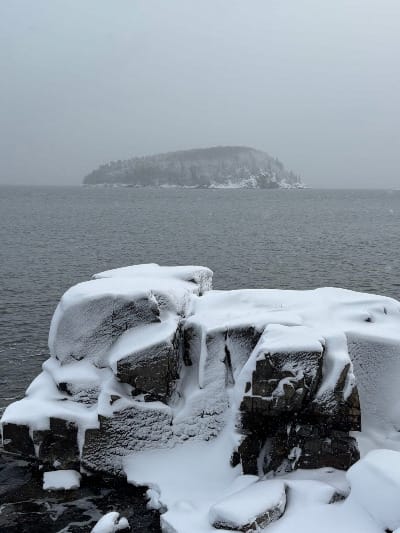
Marcia: Fieldwork to me will always be an essential part of training geoscientists. A lot of what many do is on computers, inside, analyzing data and things. But to develop the habits of mind that characterize the geological worldview, and the idea of being in four dimensions, including time, really does require physical visceral relationship with landscapes starting at a place that's familiar, and then you can kind of generalize outward from there. So even in our intro classes, right away we're getting students to see different features within maybe a 20 minute drive of here.
One of my favorite samples—to just kind of make this more concrete—is a hill that is a little bit east of town here that rises sort of suddenly out of a very marshy area. We have the students climb up; it's been excavated for sand and gravel and they climb up it and it's kind of hard to climb up. So just loose unconsolidated sand and gravel.
If they're observant, they'll notice that it's actually layered by grain size. So there are some layers that are cobble-sized rocks, and then sand, and then some layers of actual small boulders, and then more sand and then more cobbles. So it is layered, and then they can get to the top, and then they look along it and see that it's actually not just one hill. It's like an S shape, like a snake. So the hill is meandering across the landscape - that's interesting. I like to do this the very first week of Intro Geo before anybody has had any content. It's like, okay, here's this hill. How did it get here? And I let them go with that for a while and discuss, and people think, 'maybe it's a glacial deposit.' And I say, ‘Okay, we do know there were glaciers here, but glaciers just bulldoze everything, they don't sort things into these neat layers by size. But you're right, maybe glaciers were involved because there's a whole bunch of different kinds of rocks, some of which are not from around these places. So maybe the glaciers have to be involved in some way.’ Then finally somebody will say, ‘it looks like a river.’ To which I say, ‘Yeah, it does look like a river, but it's inside out. It's a positive feature. How can that happen? Think about it more.’
And finally, usually, somebody will say, ‘well maybe the walls, the banks of the river were ice. This was a river under the ice.’
Yes, that's exactly correct. A river deposit would be sorted by size when the river was flowing fast. Big things could be moved when it was slower, sand would be dropped, and this is a specific type of glacial feature called an Esker. So from not knowing anything about Geology, I give them a few hints: how glaciers leave things and the fact that some of these rocks are not local. They can, from first principles, read the story of this thing. They're like, oh my god, this is a really amazing thing. How come we can just mine it for sand and gravel for roads?
Suddenly, it has some kind of personality or some kind of meaning to them and they develop this relationship, you know, caring about it in some way. They understand it. With field work, you just, you need that mental exercise of direct relationship with the thing that you don't get if you're just looking at data sets, and being able to see in your mind's eye using that imaginative power. It can only be developed when you're there and you're really engaging with the place itself. So maybe I'm old-fashioned, but I do feel very strongly about that. And then there are just the sensory experiences of being in nature.
Also the physical, human interactions that are going on as they're talking to each other, they're forging social connections that will be somehow stored with their memory of that place. So whenever the weather permits, we’re out looking at rocks and landforms and water bodies.
Nance: Thank you. This next question is a big question, but I want to try it. There's such a diversity of timelines that we work with, there’s time as a historically and socially situated experience, there's a cultural experience of time and how we mark it, and then there's this time as a lived, everyday experience. And I'm wondering, how does understanding of geological time add to our understandings of time?
Marcia: Well, one of the cognitive habits, maybe even a super power, one develops as a geoscientist is the capacity to zoom in and out of different time scales. But if you spend enough time immersed in the logic of rocks, you begin to understand how much time different things take, what the characteristic speed of groundwater is. At the low end, maybe inches per year; at the high end, like in Door County, not good - it’s miles per year. So rates of things, how long does it take to build a mountain belt, how long does it take to open an ocean? And I think that it really does take time to understand time, you have to develop this kind of physical sense of what I sometimes call ‘temporal proportion’. There's a while ago, like the Ice Age, okay, tens of thousands to hundreds of thousands years ago. Then there's the age of the bedrock, like in the Driftless area, hundreds of millions of years old. Then there's the rock up in the UP, billions of years old, and those are order of magnitude, logarithmic differences. So getting some sense, again, of that proportionality.
A lot of students and a lot of ordinary people just have this idea of prehistory is all crunched together, and what we're trying to do is stretch this out. Know that there's lots of time here and lots of things happened. Related to that is the idea that Earth processes have many different tempos. So there's an irony to me that we, as geologists, from the time of Darwin, have been inculcating people in the idea that, in the main, geologic change is incremental and slow.
Because we've had to be on the lookout for young earth creationist types. So we say, no, the Grand Canyon did not form during Noah's flood. It was this ordinary river cutting down slowly, slowly, slowly.
So we've been inculcating people in that idea of slow, incremental change for a long time, which is true. But there's also times of rapid change. And we do know, that in the geologic past, climate can change quickly. There can be big terrible things like asteroids hitting in a day, and the world changes.
There are many tempos to the world, and that hasn't been as clearly conveyed. It's this temporal proportion thing, like, some things are fast, some things are old, but not that old, some things are really old. In an intellectual way, you can memorize dates, but it takes a while to just assimilate what a billion years means and what can happen in a billion years. It's not trivial, but it can be developed. I don't think I can claim, literally, to understand what a billion years means, but I have some glimpse of it having looked at rocks that have been with us that amount of time and what they signify.
Nance: It renders me speechless sometimes.
Marcia: One other thing that comes to mind - I've written about this - that often, in Intro Geo textbooks, they try to help people understand geologic time by using the analogy of a 24 hour clock. So if Earth formed at zero hours, here's when the first life appeared, the first animals, plants, and then humans are just right before midnight. And I don't like that analogy because, first of all, what's going to happen at midnight? Is that the end of everything? And secondly and more importantly, it's very alienating. It says 'you humans don't matter.' It's like we've just appeared out of nowhere rather than emphasizing the continuity we have with all the other living beings on the planet, and this unbroken chain of life. Continuity should be the emphasis, not how insignificant we are. Also that analogy seems to make us less culpable for all the damage we've done in that short time. So I just don't think that's helpful. It's true, it’s literally arithmetically accurate, but I think it's a bad implied set of messages. So I would rather help people develop a sense of the rates of different processes and how we fit into this continuum of life on her.
Nance: Maybe a zinger of a question… what do you know about your ancestors' relation to land?
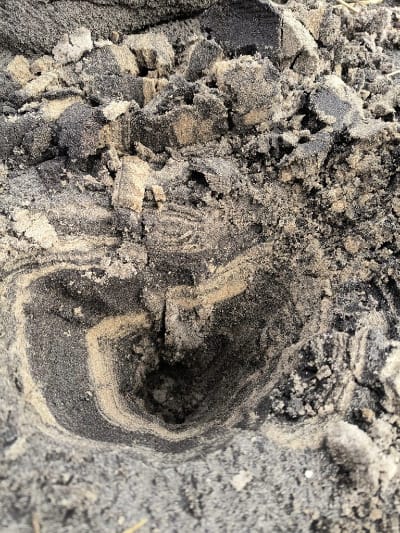
Marcia: Well, my ancestors were from Norway. One of my grandparents was even born in Norway and came as a child. And the general area they came from was very rocky. They were very poor and there were too many children in the family. They were trying to eke out a living in a place with very little soil and very little flat land. So they came and took advantage of, unfortunately, land that had been, a treaty that had been violated up in northwestern Minnesota on parts of what is the White Earth reservation, and opened to homesteading. That was in the early 1900s. My parents grew up in the same little town in northwestern Minnesota and my mom's family was a farm family and the farm that they had had been on White Earth land.
Soil dictated why my ancestors left, and they came to this very rich area along the red river of the north in northwestern Minnesota, very fertile farmland. That's not a proud story, but it illustrates how the destiny of all of us earthlings is ultimately linked with what the Earth gives us. We've found different ways of of eking out livings, sometimes by displacing people who were already there. Yeah, so those are my people, all Norwegians.
I was on sabbatical in Svalbard in the Arctic, which is a Norwegian territory, and there's this irony that, today, Norway is a very wealthy country, largely because of oil, but it's also a relatively enlightened country in using the wealth that's been generated from the oil industry over the last 50 years or so to invest in its people, to wean the country itself off fossil fuels, to invest deeply in renewable energies. There's all of these interesting ironies of how the country was and then became very rich because of fossil fuels, and is now really trying to actually lead the world away from the thing that made it so wealthy.
Nance: As a scientist, do you experience any pushback for the work that you do? Maybe not for your research, but how you can communicate to the broader public?
Marcia: Not specifically for my research on earthquakes. People are generally really interested if I tell them about what we're learning about the earthquake mechanism. But certainly, I speak to different public groups and I try to be a bridge builder. I give talks for the Kiwanis Club and the Rotary Club about climate, and sometimes that can be a challenging thing. I try to present the science in a clear and unpoliticized way, emphasizing that when the internal combustion engine was invented and when the Industrial Revolution began, we did not understand what the implications would be a hundred years later for the climate. But now that we do, it's just like in the 1800s when we were burning whale oil and it finally became unsustainable and we realized we need to change our ways.
So yeah, we're at such a polarized time. Everything can become very polemical, and I do try, in my small way, to just kind of calm down the rhetoric a little bit and emphasize the shared legacy of this verdant, wonderful Earth. And I think a more local strategy is to kind of remind people of this, the place where they live.
For example, we are here just below the Niagara escarpment. It's the one big hill, the step in the landscape that actually Niagara falls over, way to the east. So that can be an entry point talking with people about, they're often curious, 'Why is the escarpment here? What is its story?' And that can be a portal into the whole story of how, over time, the Earth has sequestered carbon dioxide in the form of limestone, like our own rocks here on the Niagara escarpment, and getting them curious about long term climate change, and then before they know it, they're understanding that we're in a pretty bad predicament now.
So finding these little portals of common ground or shared stakeholdership with people, in my experience, is the best strategy, rather than confrontation.
Soils, too are literally common ground. Most people who farm respect and understand the need to revere our soil and take care of it. I think that practice of care that you mentioned earlier is really kind of a good habit.
Nance: I would like to know what curiosities are leading your work now? Whether they be with your students or your public writing, but also your scientific research?
Marcia: As I grow older, I'm increasingly interested in the history of science and, in particular, the history of geological and geoscientific thought. One thread that I've followed for a while, which is not really a new idea but I continue to be interested in, is the Gaia idea. In the 1970s, James Lovelock, who was an atmospheric chemist and brilliant British inventor of different instruments, came up with the idea that the Earth was, in some sense, a super organism.
This idea was motivated by the fact that he was hired on contract by NASA to design some kind of instrument that could detect life on Mars when some of the first missions to Mars were planned. And the idea was he was supposed to design an instrument that could detect life on the surface of Mars remotely. And apparently, after just pondering this question, ‘What are we looking for?’ and ‘How are we trying to detect?’
He said, I can tell you right now there's no life on Mars, because we know the atmosphere is, although it's thin, it's mostly carbon dioxide - like 98% carbon dioxide - and a little bit of water vapor, and that is just volcano breath. There is nothing tinkering with the atmosphere. This is a dead planet. It's atmosphere is at equilibrium. It's just what remains after a lot of it has escaped to space.
And then he looked back at Earth and said, look at our weird atmosphere. We got all this nitrogen, but more importantly, we have oxygen - 21% oxygen - coexisting with gases that should react with oxygen, like methane. If those were in a vial in a lab together, they will react and they’ll become carbon dioxide and water. He said, clearly, if somebody were looking at Earth from outer space, they would say, oh, something is very strange about that planet. There's something maintaining it at disequilibrium.
So that was the beginning of the Gaia idea. And then it was published in a number of venues. It was actually the novelist William Golding, who wrote Lord of the Flies, who was a neighbor and friend of Lovelock's, who suggested the name Gaia, which was probably unfortunate, because then it, right away, got a New Age-y whiff about it. And that was part of the reason that in the 70s, 80s and early 90s, most scientists were very derisive of the Gaia idea.
But then, people began to see this worldview of thinking of Earth - including the rocks and the water and the atmosphere and the life forms as a system interacting in complex ways - is actually a useful lens for thinking about the Earth. I don't think we would ever use the term Gaia in a scientific paper in general, but the idea behind Gaia has now become mainstream science. The initial negative reception to the idea fascinates me. What does that say about the science of the time? And then how we got to this point where we're kind of using the conceptual framework of Gaia as our toolkit.
Lovelock was sort of an orthodox guy, and his initial way of describing it was that the Earth could maintain homeostasis like we maintain our blood sugar or our temperature within bounds. And Earth has had times of fluctuation in the climate, so it's not always maintaining a strict homeostasis, but it's never completely shut down and collapsed. The biosphere has never been vanquished. So that fascinates me - the sociology of science and the way ideas change and are initially rejected and then embraced and then modified and keep evolving.
I've been around long enough that I remember these conversations and now I can see this arc of how that idea has matured. Meanwhile, I just like nosing around in the North Woods looking for outcrops and finding things that we scratch our heads and we try to figure out and understand. I love looking at rocks under the microscope. I think this is one thing people don't appreciate is that not all geology is done at the hand specimen scale. We take thin sections of rocks, and rocks under the microscope are absolutely beautiful. If I could do stained glass, I would recreate what rocks look like in thin section in beautiful stained glass windows. They're exquisite.
Nance: You have tools to slice rock!
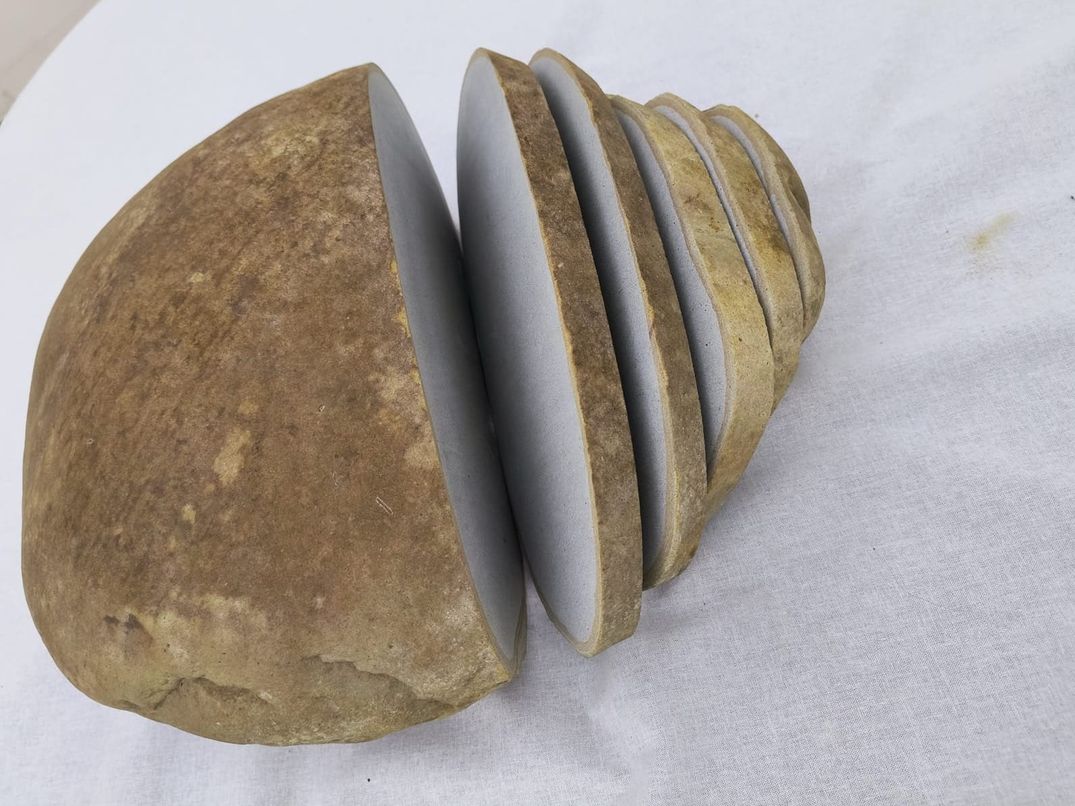
Marcia: We have rock saws, and then we glue slices onto a glass slide and then grind them down until they're transparently thin, and then we can shine light through them, and we have special filters that make them colorful. You can glean so much information from just one thin section of a rock. The experience of one rock in a place is usually an exemplar of a much larger set of processes that occurred, so you can do a lot of inductive reasoning from even a very small sample.
Nance: Love it. I was going to ask you what does it mean to be an earthling but you've answered that. Thank you for helping make the rock ledger more legible and help us spur some imagination into what we have already and what is to come.
Marcia: I think an awareness of the rocks around us can just enhance our sense of being alive now.
Nance: Yes! Thank you so much for your time, Dr. Bjornerud!